Business Meals, Gifts, and Client Entertainment: What’s Deductible in 2026?
For the modern entrepreneur, business doesn’t just happen behind a desk. It happens over coffee, during mid-flight meals, and through thoughtful tokens of appreciation sent to long-term partners. However, the tax laws surrounding these “soft” business costs are notoriously fluid.
As we move through 2026, many of the temporary pandemic-era tax reliefs have expired, and new legislation—specifically the One Big Beautiful Bill Act (OBBBA)—has introduced significant shifts in how the IRS views employee perks and office snacks.
If you’re a business owner in the Bay Area or beyond, understanding these nuances is essential to avoid red flags during audit season. Here is your definitive guide to what’s deductible this year.
- Business Meals: The 50% Rule is Back (Mostly)
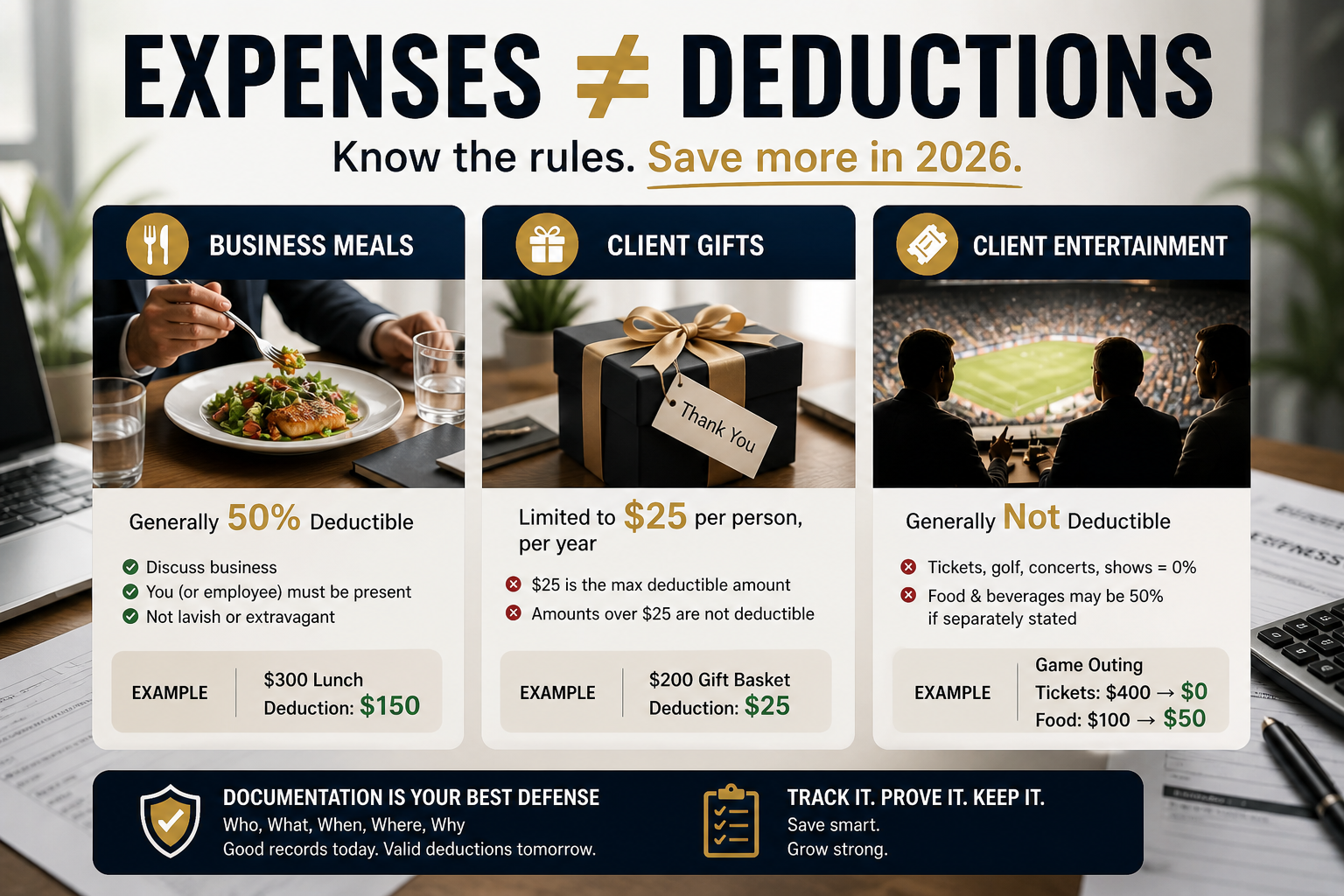
The days of the 100% “restaurant meal” deduction (a temporary COVID-era incentive) are firmly in the rearview mirror. For 2026, the baseline for most business meals has returned to 50% deductibility.
What Qualifies for the 50% Deduction?
To claim the 50% write-off, the meal must meet three primary IRS criteria:
- Business Purpose: You must be discussing business with a client, prospect, or consultant.
- Not Lavish: The expense cannot be “lavish or extravagant” under the circumstances.
- Presence: You (the owner) or an employee must be physically present at the meal.
The Big 2026 Change: No More “Convenience” Meals
Under the new OBBBA rules effective January 1, 2026, many meals previously considered 50% deductible are now 0% deductible. This includes meals provided for the “convenience of the employer,” such as:
- Office snacks and coffee.
- Dinner provided to staff working late or overtime.
- On-site company cafeterias (unless they sell food to the general public).
The Bottom Line: While you can still deduct 50% of a lunch with a potential client, the bagel spread you buy for your Monday morning staff meeting is now likely a non-deductible expense for the business.
- Client Entertainment: Still a “No-Go”
Since the 2017 Tax Cuts and Jobs Act, the IRS has held a firm line on entertainment: It is generally 0% deductible. Even if you are actively discussing a contract during the event, the following remain non-deductible:
- Tickets to sporting events (Warriors or Giants games, anyone?).
- Golf outings and country club dues.
- Concert or theater tickets.
The “Separate Invoice” Loophole
There is a silver lining. If you take a client to a baseball game and buy food and drinks at the stadium, the food and beverages can be 50% deductible—but only if they are purchased separately from the tickets or clearly itemized on a separate receipt.
- Business Gifts: The $25 Limit
While the annual “gift tax exclusion” for individuals has risen to $19,000 in 2026, the rules for business gifts are much more restrictive.
You can only deduct up to $25 per person, per year for business gifts.
- Inclusions: If you send a $100 bottle of wine to a client, you can only write off $25 of it.
- Exceptions: Incidental items like packaging, insurance, or engraving do not count toward the $25 limit. Additionally, branded “swag” items (like pens or bags with your logo) that cost less than $4 and are distributed widely are generally not subject to the limit.
- Employee Morale: The 100% Exception
Despite the tightening rules on daily office snacks, the IRS still rewards you for taking care of your team as a whole. You can still deduct 100% of the costs for:
- The company holiday party.
- An annual summer picnic or team-building retreat.
- Any social event that is open to all “rank-and-file” employees (not just executives).
- Record-Keeping: Your Best Defense
The IRS is increasingly using AI-assisted reviews to flag businesses with disproportionately high meal expenses. To protect yourself, every meal receipt should have the following “Five W’s” written on the back or logged in your accounting software:
- Who: The names and titles of those present.
- What: The total cost (including tax and tip).
- When: The date.
- Where: The name of the restaurant.
- Why: The specific business topic discussed (e.g., “Reviewing Q3 marketing budget”).
FAQ: Quick Answers for 2026
Q: Can I deduct meals I eat alone while traveling?
A: Yes! If you are traveling away from your “tax home” for business, you can deduct 50% of your own meals, even if you are dining solo.
Q: Are client gifts for a married couple limited to $25?
A: Generally, yes. The IRS treats a gift to a husband and wife as a single gift unless you have a separate, independent business relationship with each of them.
Q: Is the 100% deduction for meals at fishing facilities still real?
A: Surprisingly, yes. The 2026 laws kept a very niche 100% deduction for meals provided on certain commercial fishing vessels and remote processing facilities.
d
Summary Table: 2026 Deductibility At-a-Glance
Expense Type | Deduction % | Notes |
Client Meals | 50% | Must discuss business; owner/staff must be present. |
Travel Meals | 50% | Applies when away from home overnight for work. |
Entertainment | 0% | Tickets, golf, etc. are non-deductible. |
Office Snacks/Coffee | 0% | New for 2026 (previously 50%). |
Company Holiday Party | 100% | Must be for the entire team. |
Business Gifts | $25 | Limit is per person, per year. |
Conclusion: Don’t Leave Money on the Table
Navigating the tax code is about more than just compliance; it’s about ensuring your business keeps as much of its hard-earned revenue as possible. While the 2026 rules on office perks are stricter, the core deductions for client growth and team building remain intact.
At Bay Area Accounting Solutions, we specialize in helping startups and small businesses categorize their expenses correctly so they can scale with confidence.
Want to ensure your books are audit-proof?
[Schedule a consultation with our team today] and let’s build a financial strategy that works for you.