No Tax on Tips & Overtime in 2026: What Small Business Employers Must Do Now
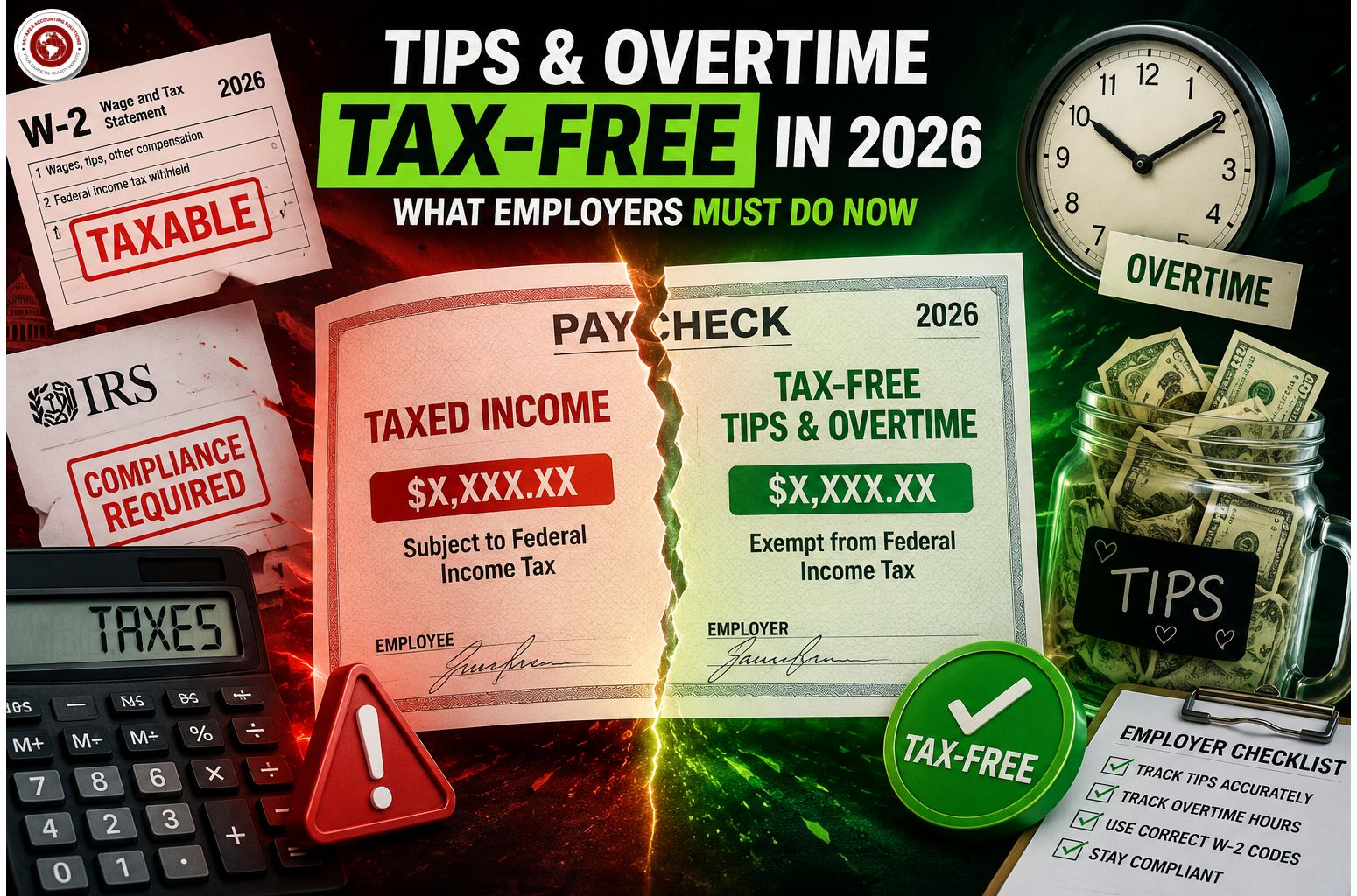
You’re running a busy bistro in Fremont, or maybe a growing HVAC crew in San Jose. You’ve finally hit your stride, but then a massive federal tax shift lands on your desk. By now, you’ve heard the headlines: Tips and overtime pay are now tax-exempt for employees.
On the surface, it sounds like a win-win. Your team takes home more money, and morale gets a boost. But as a business owner, you know that “tax-exempt” for the employee doesn’t mean “simple” for the employer. In fact, for 2026, the administrative burden of tracking these dollars has shifted squarely onto your shoulders.
If your payroll setup isn’t ready, a well-intentioned policy could turn into a compliance nightmare. At Bay Area Accounting Solutions, we’re seeing a lot of “deer in the headlights” looks from entrepreneurs. Let’s break down exactly what you need to do to stay compliant, keep your team happy, and ensure your reporting is bulletproof.
Why This Change Isn’t as Simple as “Checking a Box”
In the past, a dollar was a dollar. Whether it was base pay, a tip, or time-and-a-half, it all went into the same bucket for federal withholding. Those days are gone.
For the 2026 tax year, the IRS requires strict segregation of these funds. You aren’t just paying people; you are categorizing every cent based on its origin. If you misclassify regular wages as “tax-free overtime,” you’re looking at back taxes and penalties. If you fail to report tips correctly under the new codes, your employees might face issues with their own tax filings, and you’ll be the first person they call.
The Big Three: What’s Actually Changing?
To keep your business running smoothly in the Bay Area’s competitive market, you need to master three specific areas of this new law:
- New W-2 Reporting Codes
The IRS has introduced specific codes for the 2026 tax year to distinguish between taxable and non-taxable income. You can no longer just lump everything into “Box 1.”
- Exempt Tips: These must now be reported in a dedicated subsection to ensure they aren’t factored into the employee’s federal income tax liability.
- Exempt Overtime: Similar to tips, overtime hours and the resulting pay now require their own line item.
- Precise Hours Tracking
“Roughly 40 hours” doesn’t cut it anymore. Because overtime is now tax-exempt, the exact minute an employee crosses that 40-hour threshold (or the daily threshold in California) matters more than ever. You need a digital paper trail that proves why certain earnings were marked as tax-exempt.
- Employer-Side Taxes
Here is the kicker: while the federal income tax for the employee is gone on these amounts, your responsibilities for FICA (Social Security and Medicare) and FUTA (Unemployment) may still apply depending on final state-level reconciliations. In California, we also have to navigate how the EDD views these changes compared to the federal government.
Step-by-Step: Preparing Your Payroll for 2026
If you’re feeling overwhelmed, don’t worry. Most of these hurdles can be cleared with a proactive approach. Here is your checklist for the coming months.
Update Your Point-of-Sale (POS) and Time-Tracking Systems
Whether you’re using Toast for a restaurant or Jobber for a service business, your software needs to talk to your payroll system fluently.
- For Tip-Based Businesses: Ensure your POS isn’t just recording the total tip, but is also categorizing it (cash vs. digital) and syncing it to the new tax-exempt fields in your payroll software.
- For Hourly Teams: If you’re still using paper timesheets, 2026 is the year to stop. You need a system that automatically calculates the “tax-exempt” portion of overtime pay to avoid manual math errors.
Audit Your Employee Handbooks
Your team is going to have questions. When they see their first paycheck in 2026, they’ll notice their take-home pay is higher, but their W-2 looks different.
- Update your policies to explain how tips are tracked.
- Clarify that “tax-exempt” does not mean “unreported.”
- Ensure your staff understands that they still need to report all tips to you so you can document them properly.
Watch Out for the “California Divergence”
As a Bay Area business, you’re used to California doing things its own way. While federal law has changed, California’s Franchise Tax Board (FTB) may not perfectly align with federal exemptions. This means you might have a situation where overtime is exempt from federal tax but still subject to state tax.
Practical Tip: Don’t assume “tax-free” means “zero withholding” across the board. Always check the dual-filing requirements for California employers.
The Compliance Risks: What Could Go Wrong?
We hate to be the bearers of bad news, but the IRS is expected to be particularly strict during this transition. They want to ensure businesses aren’t “disguising” regular wages as overtime to help employees avoid taxes.
- The “Reclassification” Trap: If you suddenly start paying your employees a lower base wage but “guaranteeing” them 10 hours of overtime, it will raise a red flag. The IRS views this as a tax-evasion scheme.
- Audit Trails: If you are audited, you must be able to produce time logs that justify every tax-exempt dollar paid.
- Underpayment of FICA: If you miscalculate the employer portion of payroll taxes because you thought the entire amount was exempt, you’ll be liable for the shortfall plus interest.
Why Outsourcing is No Longer a Luxury
In years past, a savvy business owner could manage payroll with a spreadsheet and a little bit of grit. In 2026, that’s a recipe for a massive headache.
When you work with a professional firm like Bay Area Accounting Solutions, we handle the technical heavy lifting so you can focus on your customers. Here’s how we bridge the gap:
- Software Integration: We help you sync your POS and time-tracking so the data flows correctly without manual entry.
- Regulatory Monitoring: We stay on top of the latest “Internal Revenue Bulletins” so you don’t have to spend your weekends reading tax code.
- Local Expertise: Based right here in Fremont, we understand the specific challenges of running a business in the Bay Area, from high labor costs to complex California labor laws.
- Error Prevention: We catch the “new W-2 code” errors before they ever reach the IRS, saving you from costly amended filings.
Real-World Example: The Service Contractor
Imagine a small electrical contracting firm in San Leandro. They have five technicians who regularly work 50 hours a week during the summer peak.
Under the old rules, the owner just sent the total hours to a basic payroll processor. In 2026, that owner needs to ensure that the 10 hours of overtime are coded correctly so the technicians get their tax-free benefit. If the owner forgets to update the system and taxes are withheld, the employees lose out on their hard-earned money. If the owner stops withholding but fails to use the new W-2 codes, the business faces a compliance audit.
By having a dedicated accounting partner, that contractor can simply “set it and forget it,” knowing the technicians are getting paid correctly and the business is safe.
Final Thoughts: Clarity is Your Best Strategy
The 2026 changes to tips and overtime are designed to put more money in workers’ pockets, which is a great thing for our local economy. But for you, the employer, it’s a period of transition that requires attention to detail.
When your books are messy, every business decision starts feeling like a guessing game. By getting ahead of these payroll changes now, you aren’t just avoiding a penalty—you’re gaining the financial clarity you need to grow your business with confidence.
Ready to Modernize Your Payroll?
If you’re a business owner in Fremont, San Jose, or anywhere in the Greater Bay Area, don’t wait for the first payroll cycle of the year to find out your system is broken.
Bay Area Accounting Solutions specializes in helping startups and small businesses navigate complex tax shifts with ease. We’ll take the payroll and reporting off your plate so you can get back to doing what you love.
[Contact Bay Area Accounting Solutions today for a consultation. Let’s get your 2026 strategy in place.]