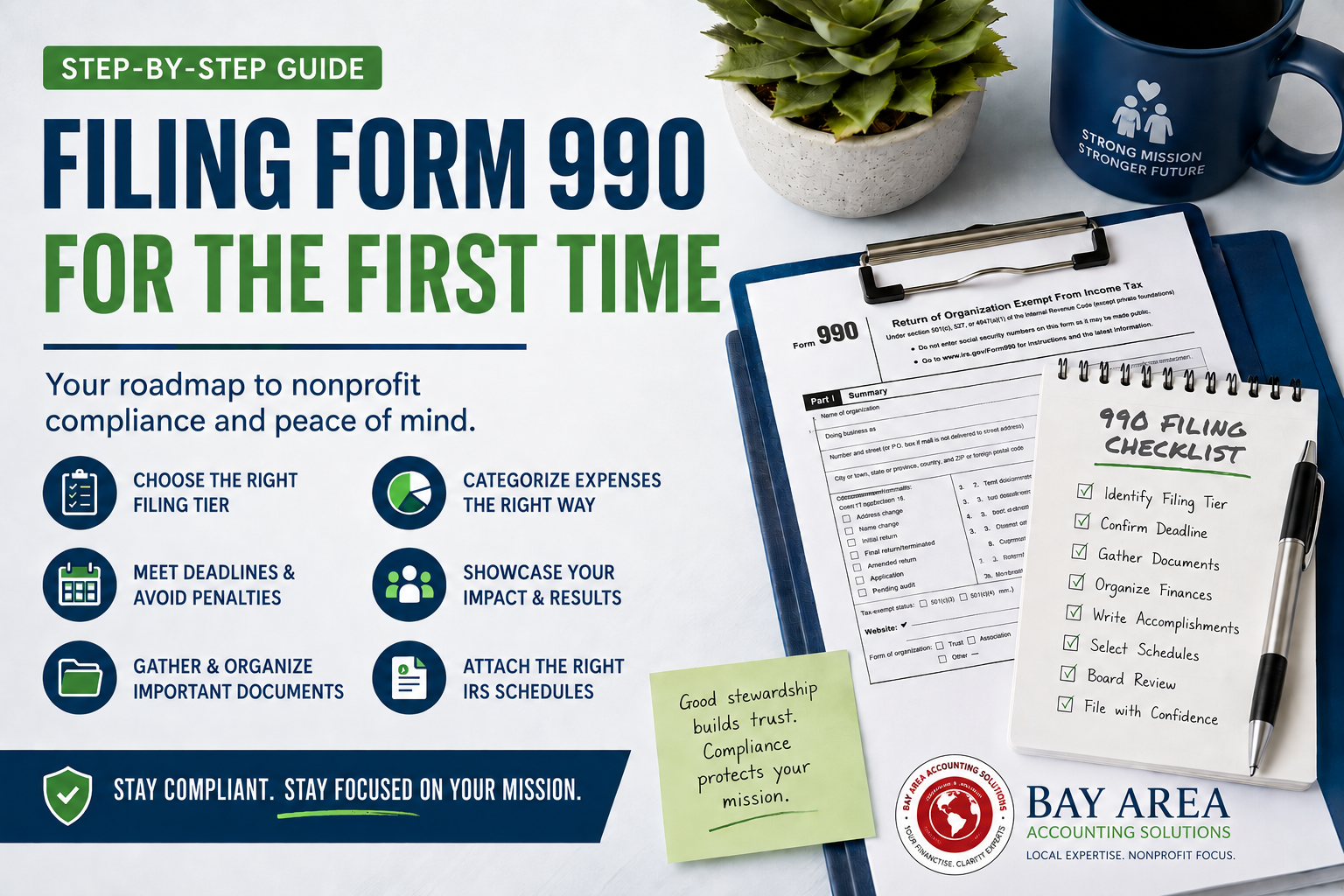
Step-by-Step Guide: Filing Form 990 for the First Time
If you are a nonprofit founder, executive director, or board member preparing to file your organization’s very first information return with the IRS, you are likely feeling overwhelmed.
Navigating tax compliance for nonprofits can feel like learning a completely different language. The IRS expects total transparency, and the numbers you report become a matter of public record. One minor mistake can trigger an audit, stall your grant applications, or—if neglected for too long—lead to the automatic revocation of your tax-exempt status.
You do not have to guess your way through the process. This comprehensive, step-by-step guide breaks down exactly how to file Form 990 for the first time, ensuring your organization stays compliant while protecting your hard-earned 501(c)(3) status.
Step 1: Identify Your Correct Filing Tier
The IRS determines which version of Form 990 you must file based on your financial thresholds (gross receipts and total assets) during the fiscal year. Filing the wrong form can result in immediate rejection.
Review the breakdown below to see where your nonprofit lands:
Form 990-N (The e-Postcard)
- File if: Gross receipts are normally $50,000 or less
- What you do: File electronically using the online Form 990-N portal. It typically takes about 15 minutes.
- What you report: Basic operational info—organization name, mailing address, website, tax ID (EIN), and a simple confirmation that your gross receipts were under the limit.
- Who doesn’t qualify: Churches, governmental organizations, and certain foreign organizations are barred from using the e-Postcard regardless of income.
Form 990-EZ (The Short Form)
- File if: Gross receipts are between $50,000 and $200,000 AND total assets are under $500,000.
- What you do: File Form 990-EZ, which is a simplified, 4-page version of the full return.
- What you report: Basic income, expenses, primary program activities, and a condensed balance sheet.
Form 990 (The Full Form)
- File if: Gross receipts exceed $200,000, total assets exceed $500,000, or your organization is a private foundation (which must file Form 990-PF).
- What you do: File the comprehensive, 12-page Form 990 along with specific corresponding Schedules (A through R) based on your exact activities.
- What you report: Complete financial statements, deep-dive program descriptions, executive compensation, related-party transactions, and a highly granular breakdown of every dollar in and out.
- The Reality: This is a complex tax return that easily takes 20 to 40 hours to prepare accurately.
Step 2: Confirm Your Deadline and Avoid Penalties
Unlike personal tax returns, Form 990 is not due on April 15th.
Your deadline is the 15th day of the 5th month following the end of your organization’s fiscal year.
- If your fiscal year aligns with the calendar year (ending December 31), your deadline is May 15th.
- If your fiscal year ends June 30, your deadline is November 15th.
What happens if you miss it?
The IRS imposes steep daily penalties for late filings, which can quickly add up to thousands of dollars. More importantly, if your nonprofit fails to file for three consecutive years, your tax-exempt status is automatically revoked. Reinstating a revoked status requires re-filing Form 1023, paying hefty user fees, and restarting the application process from scratch.
Step 3: Gather Core Corporate Data
Before you log in to your filing software, you need to compile your organization’s legal and administrative information. Gathering this beforehand prevents data mismatches that cause the IRS to reject returns.
You will need:
- Legal Name & DBAs: Must exactly match your IRS Determination Letter.
- Employer Identification Number (EIN): Your 9-digit federal tax ID.
- Current Board Roster: Names, physical addresses, and officer titles for all current directors, trustees, and key employees.
- Official Mission Statement: The primary purpose of your nonprofit, keeping it consistent with your original incorporation documents.
Step 4: Organize and Categorize Financial Records
The IRS doesn’t just want to see a single “total expenses” number. They require you to divide your spending into three functional expense categories:
- Program Service Expenses: Money spent directly on carrying out your mission (e.g., purchasing supplies for a food bank, conducting workshops, running programs).
- Management and General Expenses: Overhead costs required to run the organization (e.g., rent, bookkeeping, legal fees, board meeting expenses).
- Fundraising Expenses: Costs associated with public appeals for funds, hosting galas, or managing donor campaigns.
Step 5: Draft Narrative Accomplishments (Part III)
Form 990 is unique because it is both a financial report and a public relations document. Part III requires you to describe your top three program accomplishments from the past year.
Do not write vague descriptions like “We helped the community.” Instead, use clear, measurable metrics:
- Good Example: “Successfully operated an after-school tutoring program that served 120 low-income students, providing 450 hours of academic support and achieving a 92% graduation rate among participants.”
Because anyone can look up your Form 990 on databases like GuideStar, treat this section as an opportunity to showcase your impact to potential grant writers and major donors.
Step 6: Identify Required IRS Schedules
Depending on your nonprofit’s structure and activities, you will need to attach additional forms called “Schedules.” For first-time filers, the most common additions include:
- Schedule A (Public Charity Status): Required for all 501(c)(3) organizations to prove they receive broad public support rather than depending on a single wealthy individual.
- Schedule B (Schedule of Contributors): Used to report details on major donors who gave more than $5,000 (or 2% of total contributions).
- Schedule O (Supplemental Information): A narrative addendum used to explain answers or provide extra context requested throughout the main form.
Step 7: Implement Internal Board Review
The IRS explicitly asks on Form 990 whether a copy of the final form was provided to the organization’s governing body (the Board of Directors) before it was filed.
While a pre-filing review is not legally mandated, checking “No” on this line is a significant governance red flag for auditors. Establishing an internal policy where the board reviews and signs off on the return protects executive leadership and ensures absolute data accuracy.
Clean Up Your Books and File with Confidence
Filing your first Form 990 is a major milestone, but it shouldn’t distract you from the community work you love. The best way to guarantee a stress-free filing season is to maintain clean, professional bookkeeping throughout the entire year.
At Bay Area Accounting Solutions, we specialize in helping small-to-midsize nonprofits navigate complex federal compliance, payroll, and fund accounting. Based right here in Fremont, California, we function as your local financial partner, giving your board and your donors total peace of mind.
Ready to take the stress out of your compliance?
- Schedule a Free 30-Minute Consultation: Talk directly with a nonprofit accounting specialist to review your current financials, confirm your filing tier, and map out your path to compliance.
- Contact Us Locally: Call our Fremont team today at +1 (510) 962-7300 or email us directly at [email protected].