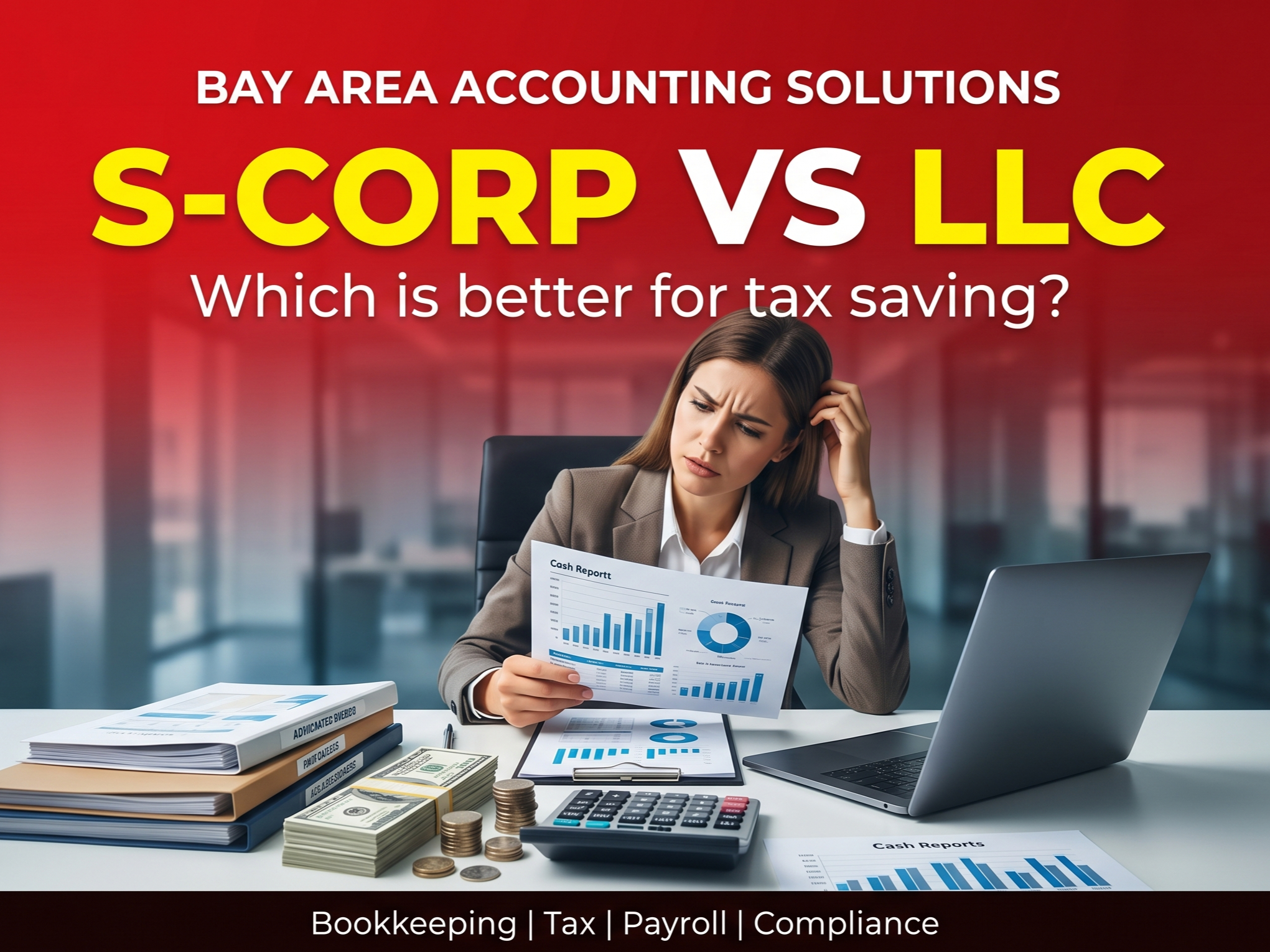
S-Corp vs LLC: Which Is Better for Tax Savings?
Every week a small business owner asks us the same question: “My friend said I should set up an S-Corp to save on taxes. Should I?”
Sometimes the answer is yes. Sometimes it is an expensive mistake. The right choice depends on how much profit your business makes. Most free advice online skips this important part.
In this post we keep it simple. We explain the real difference between the two structures so you can see which one might put more money in your pocket.
First, let’s clear up the confusion
An LLC and an S-Corp are not the same thing.
An LLC is a legal business structure that protects your personal assets from business debts. It is a state-level choice.
An S-Corp is not a business structure. It is a tax election. It is simply how you ask the IRS to tax your business.
You can run an LLC and still elect S-Corp tax treatment. The two can work together.
Most people who ask about “S-Corp vs LLC” really mean this: Should I stay as a single-member LLC taxed like a sole proprietorship, or should I elect S-Corp status?
The core difference: self-employment tax
When you run a standard single-member LLC, the IRS treats all your business profit as personal income. You pay self-employment tax on the full amount.
This tax covers Social Security and Medicare.
An S-Corp changes that.
It lets you split your income into two parts: salary (W-2 income) and distribution (remaining profit).
You pay payroll taxes only on the salary.
The remaining profit is not subject to self-employment tax.
That simple split is the entire tax-saving idea.
When does an S-Corp actually make sense?
The honest answer is: not always.
The benefit only appears when your business profit is high enough.
Below a certain level, the extra paperwork and accounting costs can cancel out any advantage.
As a general rule: an S-Corp election starts to make sense once your profit is high enough that tax savings outweigh the added complexity.
If your profit is still modest, it is usually simpler to stay as a standard LLC.
LLC vs S-Corp at a glance
Standard LLC:
– Self-employment tax on all profits
– Simple setup
– Low admin burden
– Lower accounting cost
– Better for lower profits
– Flexible ownership
LLC with S-Corp:
– Tax only on salary portion
– Moderate setup complexity
– Higher admin burden
– Higher accounting cost
– Better for higher profits
– More ownership restrictions
Other factors to consider
– The IRS requires S-Corp owners to pay themselves a reasonable salary.
– Setting the salary too low can cause issues.
– S-Corps have ownership restrictions.
– This can affect fundraising or adding partners.
– The Qualified Business Income (QBI) deduction applies to both.
– You can switch to S-Corp later, but switching back is harder.
So — which should you choose?
– If your profit is low → Stick with LLC
– If your profit is growing → Consider S-Corp
– If you want investors → Be careful with S-Corp
– If you want simplicity → LLC is better
The right choice depends on: profit level, growth plans, state rules, and tolerance for admin work.
Final thought
Neither structure is always better.
The smartest move: run your numbers with a professional who understands your full situation.
Not sure which structure is right for you?
We can review your situation for free.
Our team helps small business owners choose the right structure, handle setup, and stay compliant