Bookkeeping
Your Nonprofit Is Growing. Is Your Accounting Keeping Up?
By BAAS Team · · 6 min read
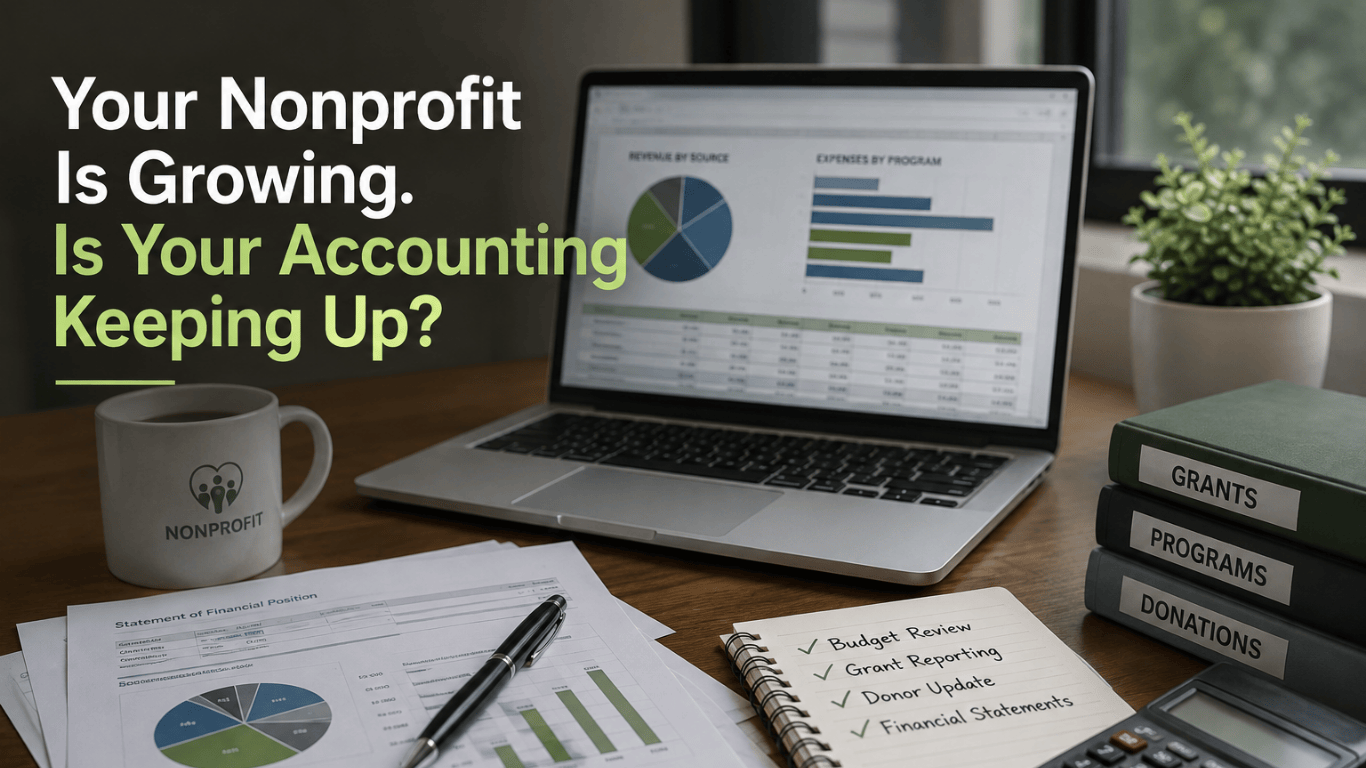
At first, accounting for a nonprofit can feel simple.
You have a bank account. A few donations come in. You pay some bills. Maybe you have a grant or two. You keep your receipts organized and check the bank balance from time to time.
Then something changes.
Your nonprofit starts growing.
More donations come in. You receive a major grant. You hire employees. You run more programs. You have more vendors, more expenses, and more people asking where the money is going.
Suddenly, the accounting system that worked when you were small starts struggling to keep up.
That's when nonprofit leaders need to ask:
Is our accounting growing with us—or are we trying to make an old system work for a bigger organization?
Growth Changes Everything
Growth is exciting.
It means your organization is reaching more people, attracting more support, and creating a bigger impact.
But financial complexity grows right alongside it.
More transactions. More grants. More employees. More reporting. More compliance requirements. And more people who need accurate financial information.
Your accounting needs to keep pace.
Your Bank Balance Doesn't Tell the Whole Story
One of the biggest mistakes a growing nonprofit can make is relying too heavily on its bank balance.
You might look at your account and think:
"We have $150,000 in the bank. We're doing fine."
But what if $75,000 is restricted for a specific grant?
What if another $30,000 is needed for payroll and upcoming expenses?
What if other funds are committed to specific programs?
The bank balance tells you how much cash is sitting in the account. It doesn't necessarily tell you how much money is actually available to spend.
Good nonprofit accounting helps leadership understand where money came from, where it is going, what restrictions apply, and what financial commitments are coming next.
Grants Can Make Accounting More Complicated
Receiving a large grant is a major achievement.
But a grant isn't simply money deposited into your bank account.
Depending on the grant agreement, there may be specific requirements for how the funds can be used, how expenses must be documented, and what reports must be submitted.
Imagine receiving a $100,000 grant for a community program.
You spend $20,000 on salaries, $15,000 on supplies, $10,000 on transportation, and $5,000 on administrative expenses.
Six months later, someone asks:
"How much of the grant have we spent, and how much is remaining?"
If answering that question requires searching through spreadsheets, receipts, emails, and bank statements, you have a problem.
Grant tracking should be part of your accounting process from the beginning—not something you try to reconstruct when the reporting deadline arrives.
Your Board Needs More Than a Bank Statement
Nonprofit boards need accurate financial information to make informed decisions.
They may ask:
- Are we operating within our budget?
- How much cash do we have available?
- How much money is restricted?
- Are program expenses increasing?
- Are we financially sustainable?
- Are we meeting our financial goals?
If answering these questions takes hours of searching through spreadsheets and documents, your accounting system may not be giving leadership what it needs.
Good financial reporting turns numbers into information—and information helps boards make better decisions.
When Accounting Becomes Reactive
Another warning sign is that you're constantly reacting.
A donor asks for information—and someone has to search for it.
A grant report is due—and someone starts digging through spreadsheets.
A board meeting is approaching—and financial statements aren't ready.
An auditor requests documents—and everyone starts looking through folders.
A vendor asks about a payment—and nobody is sure what happened.
This isn't necessarily a people problem.
Sometimes, it's a system problem.
Your team may be working hard, but if your accounting process wasn't designed for your organization's current size and complexity, even good people can spend too much time chasing information.
What Does Good Nonprofit Accounting Look Like?
A strong nonprofit accounting system should help leadership understand the organization—not just record transactions.
Depending on your needs, that may include:
Accurate Bookkeeping
Transactions are recorded correctly and consistently.
Grant and Fund Tracking
Funding is tracked according to applicable restrictions and requirements.
Budget vs. Actual Reporting
Leadership can quickly see whether income and expenses are on track.
Clear Financial Statements
Reports are understandable to executives and board members—not just accountants.
Organized Documentation
Invoices, receipts, grant records, and other financial documents are easy to find.
Timely Reporting
Financial information is available when decisions need to be made.
The goal isn't simply to have clean books.
The goal is to have financial information that helps your nonprofit make better decisions.
Has Your Nonprofit Outgrown Its Accounting?
There isn't one revenue number that tells you it's time to upgrade.
Look for the signs.
Your nonprofit may have outgrown its current accounting process if:
- You're managing multiple grants or funding sources.
- Your transaction volume has increased significantly.
- You're relying heavily on spreadsheets.
- Financial reports take too long to prepare.
- Board members can't easily get the information they need.
- Grant reporting is becoming difficult.
- You're not confident your financial statements are accurate.
- Your accountant spends more time fixing problems than providing useful insight.
If several of these sound familiar, your nonprofit may not need to work harder.
It may need a better accounting system.
Accounting Should Support Your Mission
Nonprofits exist to make an impact.
Whether you're supporting children, feeding families, providing healthcare, helping veterans, protecting the environment, or advancing education, your financial resources exist to support that mission.
Every dollar matters.
Strong accounting gives you better visibility into how those resources are being used, whether programs are financially sustainable, and whether your organization is prepared for what's next.
Growth is a good problem to have.
But your accounting needs to grow with it.
Your mission is growing. Your financial systems should be growing with it.
How Bay Area Accounting Solutions Can Help
At Bay Area Accounting Solutions, we help organizations maintain accurate, organized, and useful financial information as they grow.
Our accounting and bookkeeping support can help nonprofits with:
- Bookkeeping and accounting
- Financial reporting
- Accounts payable and receivable
- Payroll
- Budget and cash-flow support
- QuickBooks setup and cleanup
- Ongoing accounting support
The goal isn't just to keep your books updated.
It's to give you the financial clarity you need to make decisions with confidence.
If your nonprofit has grown faster than its accounting processes, let's talk.
📞 +1 (510) 962-7300