Business Formation
Nonprofit 501(c)(3) vs 501(c)(4) vs 501(c)(6): Which Should You Choose?
By BAAS Team · · 6 min read
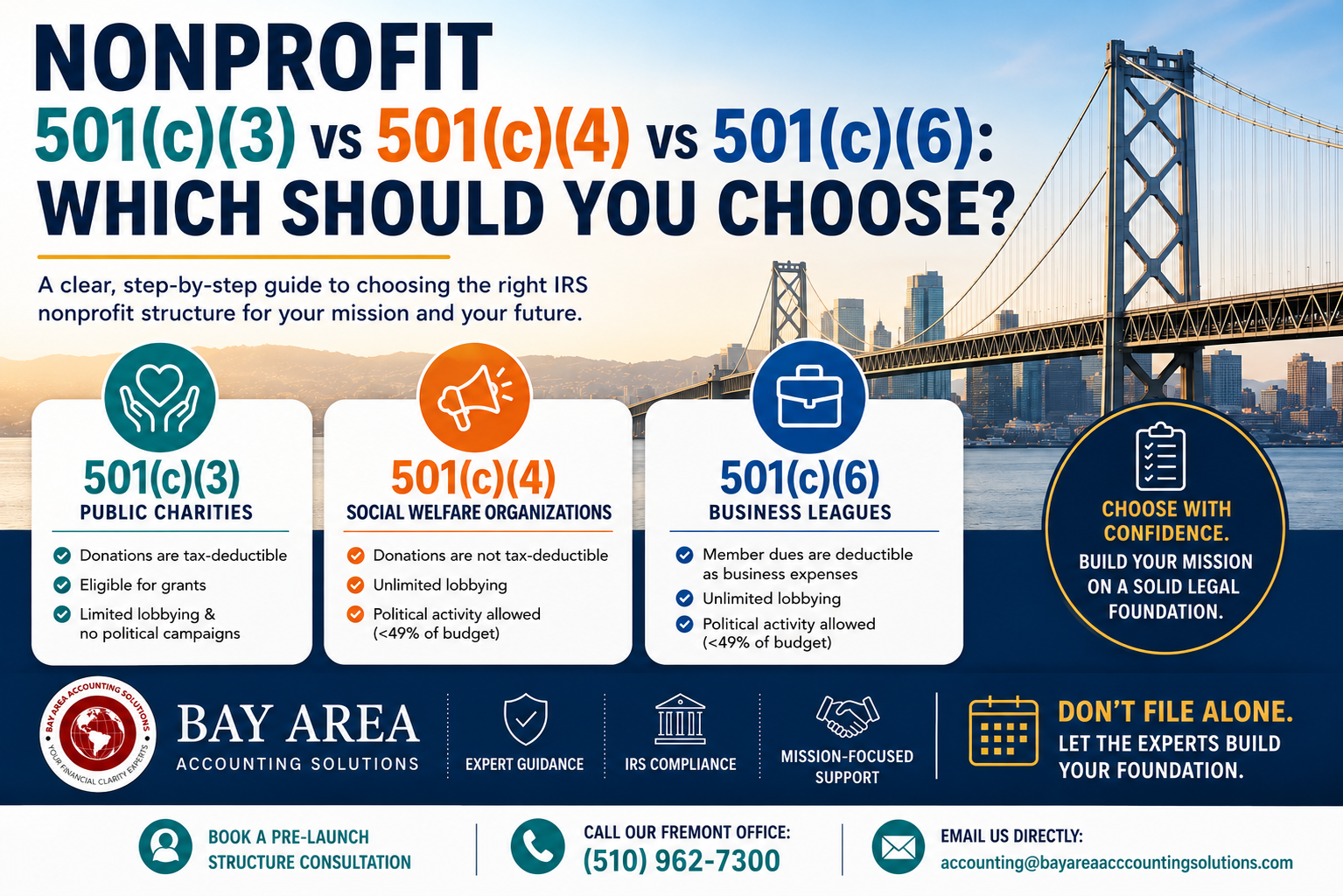
Choosing the wrong legal structure when launching an organization is one of the most expensive mistakes a founder can make. If you select the wrong IRS classification, you can accidentally lock yourself out of grant funding, void your donors' tax deductions, or face immediate rejection from the IRS.
While the IRS recognizes over 29 different types of 501(c) organizations, three structures dominate the landscape: 501(c)(3) public charities, 501(c)(4) social welfare organizations, and 501(c)(6) business leagues.
This guide strips away the legal jargon to deliver a step-by-step decision tree, precise financial implications, and the exact filing costs for each path so you can build your entity on a rock-solid foundation.
Part 1: The Core Differences Breakdown
Before looking at the mechanics, it helps to understand what the IRS intends each structure to accomplish and how they differ fundamentally in operational rules.
1. 501(c)(3) Public Charities & Foundations
- Primary Purpose: Organized exclusively for religious, charitable, scientific, literary, or educational purposes. Common examples include food banks, private schools, youth sports leagues, and animal shelters.
- Tax-Deductibility: Individual and corporate donations are fully tax-deductible for the donor.
- Grant Eligibility: These organizations are the primary eligible recipients for major foundation and government grants.
- Political & Lobbying Rules: Lobbying activities are highly restricted and must remain "insubstantial." Political campaign activity (endorsing or funding candidates) is strictly prohibited.
- Compliance Checks: The organization must pass the rigorous Public Support Test annually to maintain its status.
2. 501(c)(4) Social Welfare Organizations
- Primary Purpose: Built to promote civic betterment, social improvements, and community welfare. This often includes advocacy groups, civic leagues, and grassroots political organizations.
- Tax-Deductibility: Donations are not tax-deductible for the donor.
- Grant Eligibility: They rarely qualify for standard foundation grants and often require complex fiscal sponsorship arrangements to access philanthropic capital.
- Political & Lobbying Rules: Lobbying is unlimited as long as it aligns with the organization's social welfare mission. Political campaign activity is permitted as a secondary activity, meaning it must consume less than 49% of the total annual budget.
- Compliance Checks: Exempt from the Public Support Test.
3. 501(c)(6) Business Leagues & Trade Associations
- Primary Purpose: Alliances of persons or corporations sharing a common business interest, aimed at improving commercial conditions. This covers Chambers of Commerce, real estate boards, and professional trade groups.
- Tax-Deductibility: Donations and contributions are not tax-deductible as charitable gifts. However, member dues can frequently be written off by businesses as a standard operational expense.
- Grant Eligibility: Generally ineligible for charitable foundation grants.
- Political & Lobbying Rules: Lobbying is unlimited if it directly advances the shared business interests of the industry. Political campaign activity is allowed as a secondary, minority function (<49% of budget).
- Compliance Checks: Exempt from the Public Support Test.
Part 2: The Step-by-Step Decision Tree
To find your exact fit, run your vision through these three foundational questions:
Step 1: How Will You Raise Capital?
- If you rely on individual donations and foundation grants: You must file as a 501(c)(3). Major donors and philanthropic foundations will not give large sums of money if they cannot write it off on their taxes.
- If you rely on corporate membership dues or service fees: A 501(c)(6) fits best. Businesses can write off their membership dues to your organization as a standard operational business expense.
- If you rely on large political donors or advocacy-driven capital: A 501(c)(4) is ideal. They can fund your advocacy without their identities being automatically exposed on public donor schedules.
Step 2: What is Your Stance on Political Action?
- If your primary goal is to get legislation passed or endorse political candidates: Avoid 501(c)(3) status entirely. The moment a 501(c)(3) endorses a candidate, the IRS can revoke its tax exemption.
- If your primary goal is lobbying or grassroots policy battles: A 501(c)(4) allows you to lobby heavily, run public issue ads, and support campaigns as long as political activity doesn't consume the majority of your budget.
Step 3: Who Benefits From Your Work?
- The General Public: 501(c)(3) or 501(c)(4). Your programs must benefit the broader community, not a selective group.
- A Specific Industry or Profession: 501(c)(6). If you are building a network to improve commercial conditions for local general contractors, specialty trades, or boutique stone companies, the IRS requires a 501(c)(6) business league.
Part 3: IRS Filing Costs & Setup Friction
The initial friction and compliance requirements vary dynamically depending on the path you choose:
- The 501(c)(3) Path (Form 1023): The IRS filing fee is $275 for Form 1023-EZ (if gross receipts are projected under $50,000/year) or $600 for the standard Form 1023. Expect a timeline of 2 to 6+ months for IRS approval. Setup friction is high, requiring comprehensive bylaws, a robust conflict-of-interest policy, and a detailed 3-year narrative financial budget.
- The 501(c)(4) and 501(c)(6) Path (Form 1024 / Form 8976): The IRS filing fee is $600 for Form 1024 (Application for Recognition of Exemption). For 501(c)(4)s, you must also submit Form 8976 (Notice of Intent to Operate) within 60 days of formation, which carries a small electronic fee. The timeline ranges from 3 to 7 months for full determination letters. Friction is medium, though serious organizations apply formally to give corporate backers confidence.
Part 4: Critical Pitfalls to Avoid
- The 501(c)(3) Public Support Trap: If you choose 501(c)(3) status but your funding comes entirely from you and one close partner, you will fail the Public Support Test. The IRS will reclassify you as a Private Foundation, exposing your investment income to excise taxes and tightening operational rules.
- The 501(c)(6) Private Benefit Trap: A business league cannot perform specific operational services for individual members (e.g., providing free bookkeeping just for one member's business). It must look at the macro picture, improving the business climate for the entire industry segment.
Don’t File Alone: Let the Experts Build Your Foundation
Deciding your entity structure isn't just about paperwork—it establishes your operational boundaries for years to come. Mistakes made during this pre-launch phase can cause the IRS to reject your application, wasting your filing fees and delaying your launch by months.
At Bay Area Accounting Solutions, we specialize in taking founders from concept to IRS-approved reality. Whether you need a full-service 501(c)(3) Application Package or a strategic Entity Structure Consultation, we structure your governance, bylaws, and financial frameworks correctly from day one.
Before you file your state articles, let's make sure you're picking the right path.
[BOOK A PRE-LAUNCH STRUCTURE CONSULTATION]
📞 Call our Fremont Office: 5109627300
📧 Email us directly: accounting@bayareaaccountingsolutions.com